 Control Laboral App
 · Windows + Web
Excel timesheets or time tracking software: choose by workflow
A spreadsheet and a shared time tracking system can both help organise working-time records. The useful comparison is what your team must do every day to produce accurate, reviewed information. Start with collection, corrections, monthly review and access. Then consider whether application activity or leave requests are part of the same problem.
By Control Laboral App · Updated
EUR 4 per employee per month, excluding applicable taxes. 14-day trial without a card.
Email us in English and receive a reply in English. The current application interface is Spanish.
When a spreadsheet is a reasonable starting point
A small team with a stable working pattern may manage a monthly workbook comfortably. The advantages are familiar editing and a format people can inspect. The cost is the work of distributing files, checking entries, resolving versions and collecting approvals. Give that process a named owner. A free template is useful only if people actually complete it and someone reviews the result.
What changes with Windows employee clocking
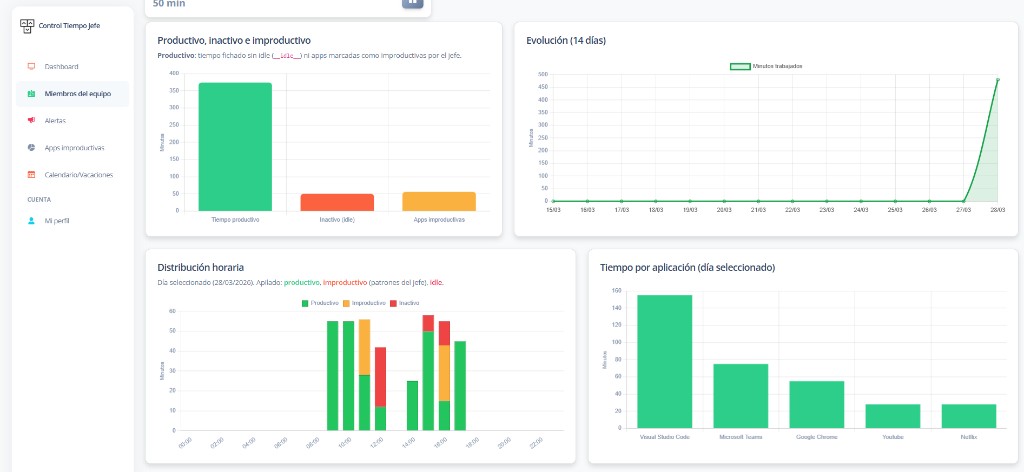
With Control Laboral App, employees start and stop their working day using the Windows client. Managers consult the records through the web dashboard rather than asking for separate workbooks. They can export employee time records as CSV for spreadsheet review. Application usage and inactivity provide extra desktop context; these indicators are separate from whether an employee’s work achieved the expected results.
Compare the full administrative effort
For one normal month, count the steps required to collect records, follow up omissions, review leave requests and prepare a useful file. A software subscription may reduce some manual collection while still requiring a responsible manager and agreed procedures. Compare that practical effort with the published EUR 4 per employee per month, excluding applicable taxes, rather than assuming either option has no operating cost.
Run the same example through both options
Choose several normal working days and a leave request. Check what the reviewer sees and how the result reaches the person who needs it. Confirm language and device requirements: the current software client is Windows, and the application interface is Spanish; email support and the downloadable workbook are available in English. Native mobile clocking, payroll calculations and project billing are outside the current product. Use the 14-day trial to test your actual process.
This teaching example uses fictional records and English column labels. Current product exports use Spanish headers; the table below explains their meaning.
How to read the CSV exported by the application
The translated downloadable examples help explain the columns. The current product export keeps the Spanish headings shown here; an English sample does not mean your company’s export has been translated.
One employee or the whole team: two layouts
- Individual employee download
- The file starts with two identification rows: Empleado and Usuario. After a blank row, the data table begins with Fecha, Hora inicio, Hora fin and Duración (hh:mm:ss).
- Whole-team download
- The first row contains all six headings listed below. Empleado and Usuario identify the employee on every time-record row.
| Heading in the current CSV | Meaning |
|---|---|
| Empleado | The name of the employee the record belongs to. |
| Usuario | The employee’s username; use it to distinguish and filter employees in a whole-team download. |
| Fecha | The recorded start date, in YYYY-MM-DD format. |
| Hora inicio | The recorded start time, in hh:mm:ss format. |
| Hora fin | The finish time, in hh:mm:ss format. This cell is blank while the record is still open. |
| Duración (hh:mm:ss) | The stored or calculated duration of the record. It is not a wage amount or a breakdown of application activity. |
Import the file and prepare the reporting period
The file uses UTF-8 encoding and comma-separated columns. If your spreadsheet does not separate the columns automatically, use its CSV import function. For an individual download, select the heading row after the employee identification rows.
The download includes available records that started within the last four years. It is not a monthly filter or a guarantee that four years of data exist. For a monthly review, filter Fecha and, in a whole-team download, Usuario. Keep a copy of the original CSV before preparing your review.
- What happens if a working-time record is still open when I download the CSV?
- Hora fin is blank. If the record has no stored duration, the application calculates the elapsed time from its start to the download time. Treat that figure as provisional: review and close the record through your company’s process before using it as a completed working period.
Frequently asked questions
- Is software always better than Excel?
- No. A spreadsheet can be appropriate when collection and review remain manageable. Software becomes more relevant when shared access, repetitive collection, application activity or a structured leave-request workflow solve a real problem.
- Can I still work with Excel after subscribing?
- Time records can be exported as CSV and opened in a spreadsheet. Review the file structure, date formats and required filters during the trial before depending on it for a monthly process.
- Does switching tools settle compliance requirements?
- No. The business must assess the required records, staff information, approvals and retention for its circumstances. Choosing a spreadsheet or a software product does not replace that assessment.
Explore related needs
Tell us what your team needs to manage
The button opens an email draft. Include your country, team size and work devices so we can assess the fit and setup terms.
Discuss your setup