 Control Laboral App
 · Windows + Web
My team works long hours but delivers few results
A full working day is not a list of completed outcomes. People may be busy handling messages, attending meetings or restarting work after priorities change. When the team records many hours but delivers little accepted work, review the flow of requests and decisions. The useful question is where effort stops becoming a finished result, rather than how to keep every keyboard active.
By Control Laboral App · Updated
EUR 4 per employee per month, excluding applicable taxes. 14-day trial without a card.
Email us in English and receive a reply in English. The current application interface is Spanish.
1. Agree which results matter this period
Define the few outcomes expected this period and what counts as accepted. A customer answer must resolve the question; a report may need approved figures. Keep drafts and reopened items visible without counting them as finished work.
Agree who changes priorities when urgent requests arrive. Otherwise, employees repeatedly decide which promise to break. A shared ordering decision can help more than longer days. Keep the delivery list in your existing task system; it is not a dashboard feature.
2. Examine unfinished work and avoidable repetition
Review how many requests each person has started and which ones can actually move forward. Several partly completed items can produce a busy day with few accepted outcomes. Check whether an item waits for another department, whether the owner is unclear and whether a reviewer is available. Record those reasons instead of assuming every open item represents inactive staff.
Also inspect repeated work. A customer reply that must be rewritten three times consumes effort without creating three separate results. Identify whether the cause is unclear instructions, missing training or changing requirements. An increase in output that depends on skipping required checks is not an improvement in the agreed result.
3. Use a review checklist for busy teams
Compare like with like: staffing, leave, customer demand and task complexity matter. A small review can identify a useful change, but it is not proof that a single factor caused the pattern. Invite employees to explain work that is necessary but not visible in a simple completion count.
- Choose a role and define the accepted outcomes for a comparable period.
- Review unfinished items, waiting reasons and changes of priority.
- Count corrections and reopened work in your existing work log.
- Check whether meetings and support duties explain time away from the main task.
- Agree one priority or approval change and a realistic review date.
4. Consider a fictional office-team example
A team records full working days but has only a few accepted customer files. Each employee is handling six partly completed files, and questions arrive through several chat channels. The manager introduces a shared priority list and a single person to resolve missing information. Employees finish the ready files before starting more work.
The next review checks accepted files, unresolved questions and corrections alongside working time. The example does not predict a numerical gain or describe a customer case. If the incoming files are easier during the second period, that difference also needs to appear in the explanation. The goal is a clearer process and evidence of useful delivery, rather than a target for constant screen interaction.
5. Understand what recorded hours can contribute
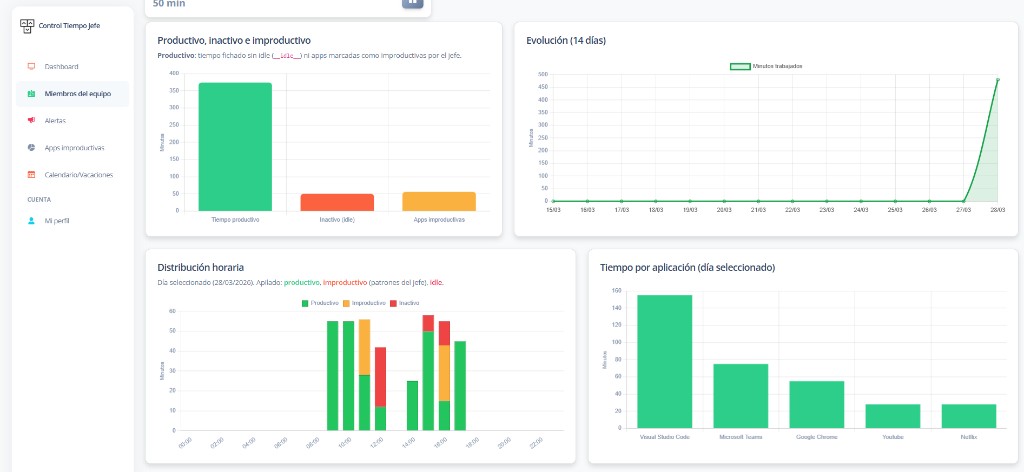
Control Laboral App lets Windows employees record their working day and gives managers a web dashboard for recorded time, application activity and inactivity. Time records can be exported as CSV for spreadsheet review. These records can help check the working period alongside agreed responsibilities, but the CSV does not automatically contain task outcomes or project profitability.
The available productive-time indicator subtracts inactivity and applications classified as unproductive from recorded time. It is a computer-activity classification. It does not establish that the remaining hours produced an accepted result. Calls, meetings, thinking and offline reading can all explain low interaction. Discuss an unexpected pattern with the employee and check role-specific classifications before deciding what it means.
Test whether desktop context improves your review
Use a pilot to answer one specific question, such as whether the recorded working day and available application information clarify a recurring workflow problem. Supply the outcomes and acceptance checks from your own management process. The service does not allocate working time to projects, calculate output quality or replace a task system.
Send your country, employee count, Windows equipment and language needs before requesting setup. The application interface is currently Spanish; email support is available in English. The published subscription is EUR 4 per employee per month, excluding applicable taxes. The 14-day trial requires no card and should be used to verify the actual workflow with a representative employee and reviewer.
Frequently asked questions
- Do longer working hours guarantee higher productivity?
- No. Review accepted outcomes, quality, waiting and workload. More recorded time does not automatically resolve unclear priorities or a blocked approval process.
- Can I divide completed tasks by recorded hours?
- You can use that calculation in your own analysis when tasks are genuinely comparable and acceptance is consistent. The product does not calculate it automatically, and the ratio alone does not explain causes or quality.
- Will a high productive-time percentage show good results?
- No. That percentage classifies aspects of computer activity. Accepted work and its quality must be reviewed separately through your company’s delivery process.
Explore related needs
Tell us what your team needs to manage
The button opens an email draft. Include your country, team size and work devices so we can assess the fit and setup terms.
Discuss your setup