 Control Laboral App
 · Windows + Web
Why are employees taking so long to finish tasks?
A task can take days to finish even when the hands-on work takes hours. Waiting for information, switching priorities and repeated review may explain the gap. Before deciding that an employee is slow, define the expected result and trace how the work moves from request to acceptance. This guide gives managers a practical review without confusing desktop activity with completed work.
By Control Laboral App · Updated
EUR 4 per employee per month, excluding applicable taxes. 14-day trial without a card.
Email us in English and receive a reply in English. The current application interface is Spanish.
1. Separate completion time from hands-on effort
Record when a request is ready, when work happens and when the result is accepted. Completion can include a customer delay, manager review or queue behind higher-priority work. These causes need different actions. Pressure on the employee will not supply a document that the customer has not sent.
Use your existing task system or a simple review log for those events. Control Laboral App records working-time intervals and application activity, but it does not allocate that time to tasks or projects. A CSV of recorded hours cannot automatically tell you how much of a day belonged to a particular request.
2. Describe a complete task before setting a target
Ask the requester and reviewer what must be present for acceptance. Include required documents, calculations, response format and who approves the work. When the instructions change after submission, record that separately from an avoidable mistake. A vague request makes it difficult to distinguish slow execution from repeated discovery of what the requester actually wanted.
Compare similar tasks for the same role and complexity. A routine query and a disputed account are not equivalent. Involve employees in expectations, including training, accessibility needs and unfamiliar systems. Avoid rewarding new starts while requests remain unfinished.
3. Trace a small sample of delayed tasks
A short sample is useful for finding questions, not for making a universal judgment about an employee. Review the normal range of work and include difficult cases explicitly. Confirm the explanation with the people involved instead of relying on a timestamp without context.
- Check whether the task had the inputs required to start.
- List the main work and review steps in the existing work log.
- Separate waiting and priority changes from hands-on effort.
- Record why work returned for correction or clarification.
- Choose the most frequent avoidable delay and assign a responsible person.
4. Use a fictional example to locate the delay
An internal report is delivered after three days. The employee spends two hours assembling it, then waits for a sales figure and a manager decision. The team initially asks for faster typing. The review instead leads to a clear submission deadline for the missing figure and a named backup reviewer.
In a different task, the main problem may be repeated formatting corrections or an unfamiliar application. The appropriate change could then be a template or training. These examples are fictional; the software does not automatically discover the cause or promise a reduction in completion time. Measure comparable work after the change and note other conditions that may have influenced it.
5. Add available computer information carefully
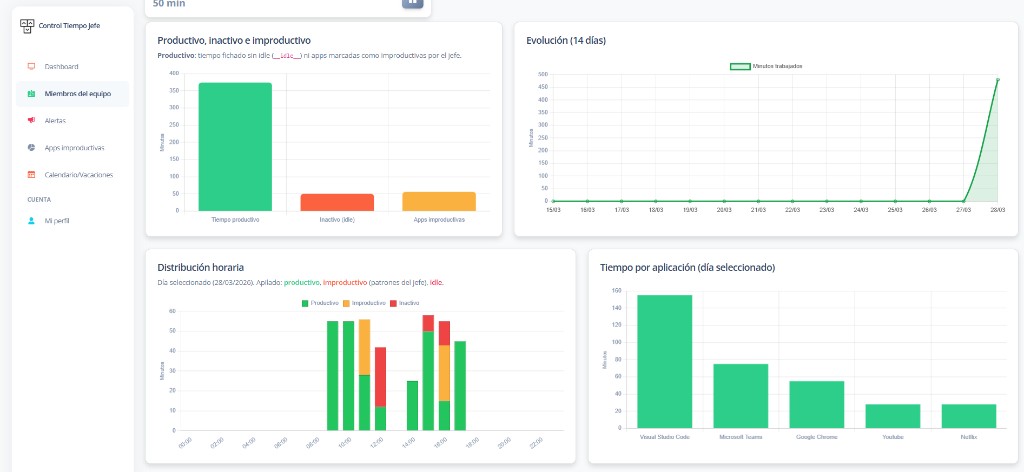
Windows application activity can provide supporting context when an employee reports a technical obstacle or frequent switching between tools. Control Laboral App also shows recorded working time and inactivity in its manager web dashboard. Check whether the available detail answers the question before collecting information that does not improve the review.
A gap in keyboard or mouse interaction can coincide with a customer call or planning. A long period in an application does not prove that one task occupied that whole period. Review application classifications against the role and discuss the relevant interval with the employee. Do not convert the activity indicator into an automatic estimate of task quality, effort or blame.
Turn the review into one practical change
Agree one action, such as a clearer request template, a protected work period or a backup approver. Revisit the same task category using the same acceptance criteria and review quality as well as speed. Your own task log must supply completion and review outcomes; the activity tool supplies only the supported time and desktop context.
For a pilot, send your country, team size, Windows devices and the specific delay you want to investigate. The current employee client is Windows, and the product interface is currently Spanish; email support is available in English. Pricing is EUR 4 per employee per month, excluding applicable taxes, with a 14-day trial without a card.
Frequently asked questions
- Can the software show how long each task took?
- It does not allocate activity or working time to tasks, projects or customers. Use a separate task record for those measures and review the available Windows information as supporting context.
- Does a long completion time mean the employee worked slowly?
- No. Completion time may include queues, missing information, approvals or priority changes. Separate those delays from hands-on effort before deciding what to improve.
- Should I set the same completion target for every employee?
- Use comparable responsibilities and task complexity, with clear acceptance criteria. A common deadline can be useful, but one speed target for unrelated work can encourage shortcuts and hide difficult cases.
Explore related needs
Tell us what your team needs to manage
The button opens an email draft. Include your country, team size and work devices so we can assess the fit and setup terms.
Discuss your setup